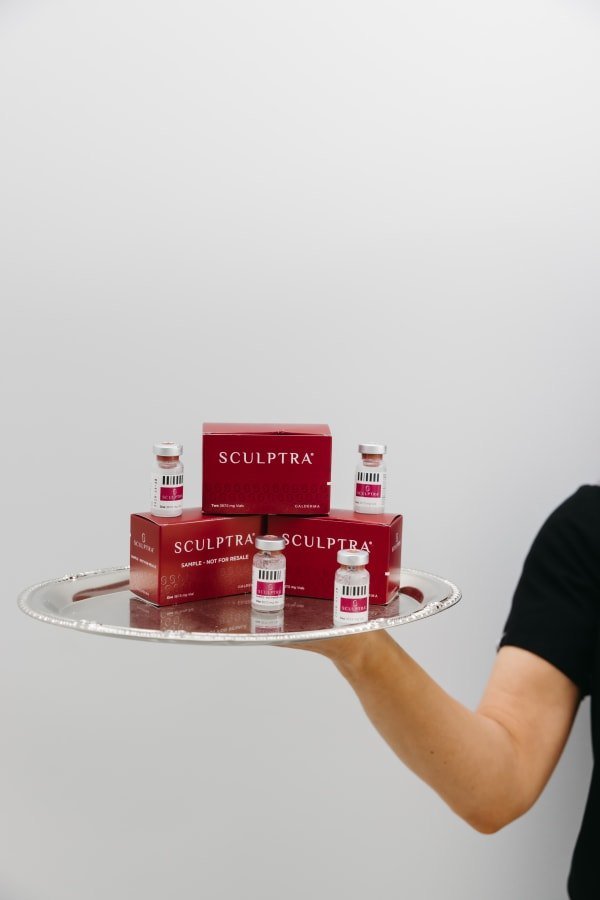

Sculptra vs. Dermal Filler: What's the Difference and Which Do You Need?
Sculptra builds your own collagen gradually; hyaluronic acid filler adds volume instantly. A Scottsdale nurse practitioner explains which one fits your goals.

Sculptra and dermal filler are both injectables that restore volume, but they do it in opposite ways. Hyaluronic acid filler is a gel that adds volume the moment it is placed, which makes it the right choice for defining a specific feature such as the lips, chin, jawline or under-eye hollows. Sculptra is a biostimulator: it contains no volume of its own but prompts your body to build new collagen over several months, which makes it the right choice for broad, foundational firmness across the cheeks, temples and lower face. If you want a precise, immediate change, choose filler. If you want your whole face to look gradually firmer and more rested, choose Sculptra. Many patients in my Scottsdale practice eventually use both, in sequence.
How dermal filler works
Most dermal fillers used today are made of hyaluronic acid, a sugar molecule that occurs naturally in skin and binds water. Manufacturers cross-link the molecules into gels of varying firmness. A soft, flexible gel suits the lips or tear troughs; a firm, structural gel suits the chin or jawline where it needs to hold a shape against the pull of muscle and gravity.
When filler is injected, the result is visible immediately. Swelling settles over one to two weeks and the final look is clear by about a month. Hyaluronic acid filler is gradually metabolized and typically lasts nine to eighteen months depending on the product, the area and how quickly your body breaks it down. It has one property that no other injectable shares: it can be dissolved with an enzyme called hyaluronidase if the result needs adjusting or in the rare event of a complication.
How Sculptra works
Sculptra is made of poly-L-lactic acid, a biocompatible material used for decades in dissolvable surgical sutures. It is supplied as a powder that is reconstituted with sterile water and lidocaine before treatment. Once injected into the deep dermis or above the bone, the microparticles act as a scaffold and a mild stimulus that prompts fibroblasts to lay down new collagen around them. Over weeks and months the particles are absorbed and the collagen remains.
Because the result is built from your own tissue rather than a gel resting under the skin, the change is gradual and looks natural. There is no “filled” appearance. Most patients notice a difference six to eight weeks after the first session, and the full result is apparent about three months after the final session in a series. Clinical studies have shown results lasting more than two years after a completed series, with a single maintenance session every one to two years helping to preserve them.
Sculptra vs. filler: side by side
| Sculptra | Hyaluronic acid filler | |
|---|---|---|
| Material | Poly-L-lactic acid (PLLA) | Cross-linked hyaluronic acid gel |
| How it works | Stimulates your own collagen | Adds volume directly |
| Onset | Gradual over 6 to 12 weeks | Immediate |
| Best for | Global firmness, hollow cheeks and temples, jawline support, skin quality | Precise definition: lips, chin, jawline, under-eyes, nasolabial folds |
| Sessions | Typically 2 to 3, four to six weeks apart | Usually one, with touch-ups as needed |
| Longevity | 2 or more years after a series | Roughly 9 to 18 months |
| Reversible | No, gradually metabolized | Yes, with hyaluronidase |
| Aftercare | Massage 5 minutes, 5 times a day, for 5 days | Avoid pressure and heavy exercise for 24 to 48 hours |
| Typical downtime | Mild swelling or bruising for a few days | Mild swelling or bruising for a few days |
| Off-face uses | Buttocks, décolletage, knees, cellulite dimpling, hands | Hands, some body contouring |
The key differences explained
Precision versus foundation
Filler is a sculpting tool. It lets an injector add a millimeter of projection to the chin, define a lip border or fill a specific hollow under the eye. Sculptra cannot do that with the same precision, because you are asking the body to grow tissue rather than placing a shape. What Sculptra does instead is restore the overall scaffolding of the face: the diffuse loss of collagen and fat that makes cheeks look flatter, temples look sunken and skin look thinner. It is a foundation treatment, not a detailing treatment.
Immediate versus gradual
If you have an event in three weeks, filler is the only one of the two that will make a visible difference by then. Sculptra rewards patience. This is not a drawback so much as a feature: nobody around you sees a sudden change, and the improvement continues for months after your last visit.
Reversible versus permanent while it lasts
Hyaluronic acid filler can be dissolved. Sculptra cannot, which is one reason I place it conservatively and at the correct depth. In experienced hands lumps are uncommon, and the at-home massage protocol exists to distribute the product evenly while collagen forms. Any biostimulator should be injected by a provider who understands facial anatomy well, because the result is meant to last for years.
Skin quality
Because Sculptra increases collagen in the dermis, patients often report that their skin looks thicker and more luminous, not just fuller. Filler does not meaningfully change skin quality; it changes shape. Patients whose main complaint is crepey, thin skin in the lower face tend to be better served by Sculptra, and those with laxity more than volume loss may do best with XERF skin tightening instead of either.
Who is the right candidate for filler?
You are probably a good candidate for hyaluronic acid filler if:
- You want a specific feature refined: fuller lips, a stronger chin, a sharper jawline, softer under-eye hollows or smoother nasolabial folds.
- You want to see the result immediately or have an event within the next month.
- You are new to injectables and want the reassurance that the result can be adjusted or reversed.
- Your volume loss is localized rather than global.
Who is the right candidate for Sculptra?
You are probably a good candidate for Sculptra if:
- You are in your thirties or beyond and notice that your face looks generally “deflated” or less firm rather than lacking in one place.
- You have hollowing at the temples or cheeks, softening along the jawline, or thinning, crepey skin.
- You prefer a gradual change that nobody can pinpoint.
- You are thinking in terms of years rather than months and want to reduce how often you visit for maintenance.
- You are interested in off-face treatment such as the décolletage, knees or a non-surgical buttock lift.
Neither is used during pregnancy or breastfeeding, and Sculptra is avoided in patients with certain autoimmune conditions. I review your medical history at every visit.
Do many patients use both?
Yes, and this is the most common plan I build with patients in Scottsdale. A Sculptra series rebuilds the foundation over two or three sessions. Once the collagen has matured, usually three months after the last session, a small amount of filler refines the details that Sculptra does not address: a lip border, a chin point, a tear trough. Doing it in this order often means less filler is needed than if filler had been used alone, and the result sits on firmer tissue. Patients with laxity as well as volume loss may add XERF before either injectable so that the skin envelope is tighter before volume is restored.
What to expect at a consultation
Whether you arrive asking for Sculptra or for filler, my assessment is the same. I look at bone structure, fat distribution, skin thickness and laxity separately, then explain which of those is driving what you see in the mirror. Sometimes the answer is filler, sometimes Sculptra, sometimes neither. You will have a clear plan and exact pricing from me before anything is injected, and I will never encourage you to do more in one visit than your anatomy calls for.
Frequently asked questions
Is Sculptra a filler?
Technically Sculptra is classified as a dermal filler by the FDA, but it behaves very differently from the hyaluronic acid products most people mean when they say “filler.” It adds no volume on the day of treatment; it stimulates your body to build collagen over the following months. That is why it is usually described as a biostimulator.
Which lasts longer, Sculptra or filler?
Sculptra. A completed series has been shown to last more than two years, compared with roughly nine to eighteen months for hyaluronic acid filler. Sculptra requires more sessions up front to reach that result.
Which is more natural looking?
Both look natural when placed conservatively by an experienced injector. Sculptra has a slight edge in that the change is gradual and comes from your own collagen, so there is never a moment of sudden difference. Overfilled results almost always come from too much hyaluronic acid filler placed too quickly, not from the product itself.
Can Sculptra be dissolved?
No. Hyaluronic acid filler can be dissolved with hyaluronidase; Sculptra cannot and is metabolized slowly over time. This is why conservative dosing and correct depth matter so much with biostimulators.